
How to Search Elk County Court Records
Elk County District Court records use the statewide Kansas CaseSearch system rather than a county-only database. The Kansas Judicial Branch announced CaseSearch as the new district court public records search tool, and the 13th Judicial District links Elk County users to Smart Search from its local page. CaseSearch is best when a user has a case number, party name, business name, or citation. It may show public case details, court location, filing date, status, event history, and limited document information depending on the case type and access rules.
When the online search does not answer the question, use the local fallback chain. The 13th Judicial District Elk County page says court files open to the public may be reviewed by appointment with the Clerk of the District Court, and the requester must provide the case number tied to the file. A public access computer is available separate from court offices. Written requests can be made on the district court public-record form, and the clerk's office has three business days to respond.
- Open Kansas CaseSearch and search by exact case number when that number is known.
- Use party name, business name, or citation search when the case number is not known.
- Narrow results with county, case type, case status, or date filters if those filters appear.
- Read the docket line before relying on a result, since common names can produce false matches.
- Contact the Clerk of the District Court for file review, copies, certification, or recorded hearings.
Kansas CaseSearch is one of the official sources captured for this project.
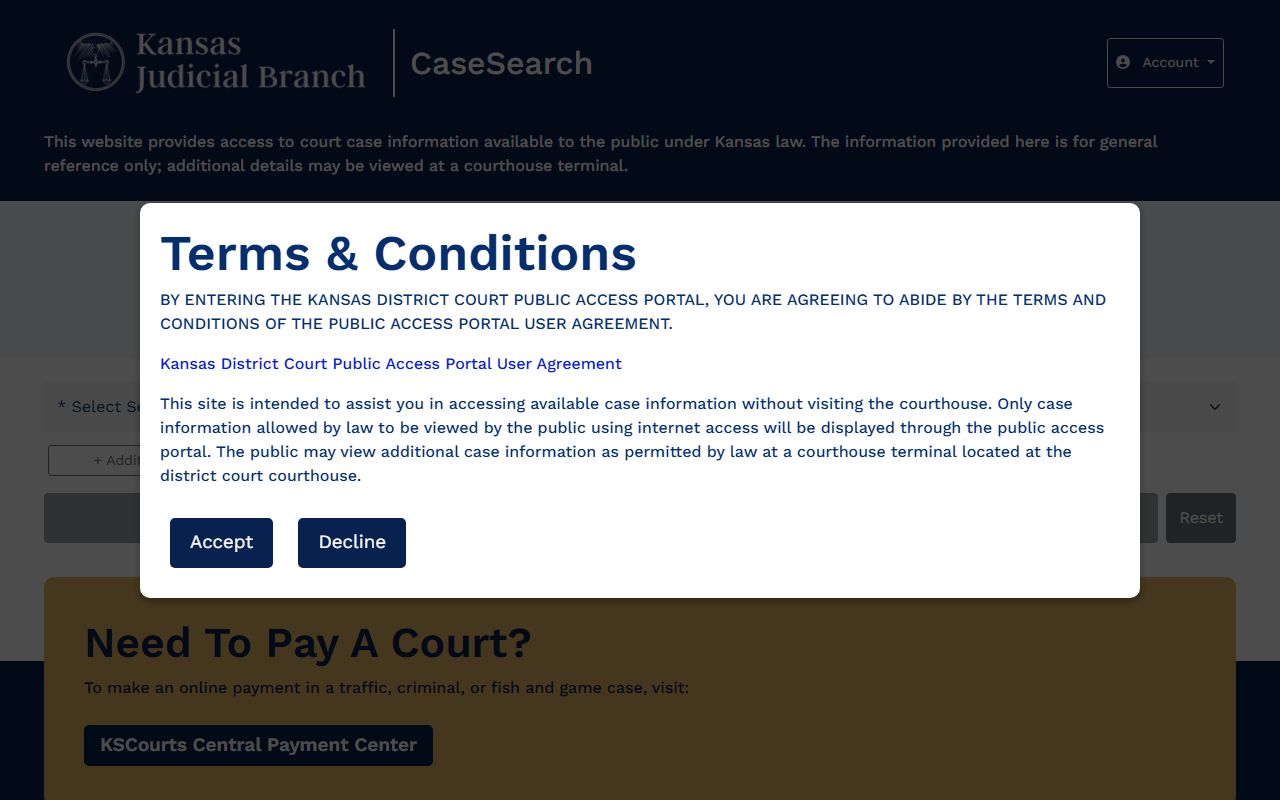
The statewide portal is the first stop for public district court records, but it does not replace certified-copy requests through the clerk.
Elk County District Court
The state trial court for Elk County is the District Court. Kansas district courts are general-jurisdiction trial courts, so the same court level handles civil, criminal, probate, family, juvenile, small claims, protection-order, traffic, and fish-and-game matters. Elk County is part of the 13th Judicial District with Butler and Greenwood counties. Local sources name Hon. Joe E. Lee as Magistrate Judge, Erin Meador as Clerk of District Court, and Tony Bauer as Court Services Officer.
The phrase "district court" can cause confusion. In Kansas, it is the county-level state trial court, not a federal court and not an appellate court. Appeals from District Court generally go to the Kansas Court of Appeals, with possible review by the Kansas Supreme Court. Howard Municipal Court is separate and handles city ordinance, traffic, and municipal misdemeanor matters.
| Court or Office | Role | Contact Point |
|---|---|---|
| Elk County District Court | State trial court for most county court records | 127 N. Pine, 2nd Floor, Howard, KS |
| Clerk of the District Court | Files, dockets, dispositions, court money, scheduling, copies | 620-374-2370 |
| Howard Municipal Court | City citations, ordinance cases, municipal misdemeanors | City Office, 110 N Pine, Howard |
| Kansas Court of Appeals | Intermediate appellate review after district court | State appellate system |
Elk County Courthouse Records
The official Elk County home page lists the courthouse at 127 N. Pine in Howard. County offices, court offices, the county attorney, and land-record offices are concentrated around the courthouse square, which matters for record searches because different record types may be on different floors or in the sheriff building nearby. District Court is on the second floor. The County Clerk and Register of Deeds are first-floor county offices. The sheriff lists 100 N. Cedar Street on the courthouse grounds.
Office hours are not identical for every office. The county home page gives county office hours as Monday through Thursday, while District Court sources give court hours Monday through Friday. The 13th Judicial District page also lists a lunch closure and a Thursday district-wide staff meeting closure for the court clerk counter. Call before making a long drive for file review, copies, a marriage license issue, or a payment question.
Clerk of the District Court
127 N. Pine, PO Box 306
Howard, KS 67349
620-374-2370
The Elk County homepage is the county source used for courthouse address and hours.
The county page is useful for courthouse-wide access details, while the District Court page controls court file and clerk details.
Elk County Court Record Types
District Court files can include several different record types. Civil files may show petitions, answers, motions, orders, judgments, garnishments, liens, execution papers, hearing notices, and satisfaction filings. Criminal files may include complaints, charging documents, bond records, pleas, motions, diversion entries, sentencing orders, probation terms, and docket events. Family records include divorce, parentage, child support, custody, and protection-order matters.
Probate is not handled by a separate county probate court in Elk County. It is a District Court probate docket. Traffic records can split between District Court cases that are payable through the Kansas Central Payment Center and Howard Municipal Court citations that follow city procedures. Juvenile records are governed by Kansas Chapter 38 and should be treated as restricted unless the clerk or court allows access.
- Civil records: lawsuits, judgments, liens, garnishments, small claims, and limited civil matters.
- Criminal records: charges, pleas, docket events, convictions, diversions, sentences, and court supervision entries.
- Family records: divorce, custody, parentage, child support, and protection-order matters.
- Probate records: estates, wills, guardianship, conservatorship, and small-estate filings.
- Traffic records: district traffic files, fine payments, and municipal citation procedures.
What Elk County Court Records Show
A court record is not one single document. It is a case file and docket history. Public fields depend on the case type and whether any part of the file is sealed. A typical Elk County District Court record may show case number, court location, case type, filing date, case status, party names, attorneys, judge or magistrate, docket events, hearing dates, disposition, financial assessments, and document references.
| Field | What It Shows |
|---|---|
| Case number | The official file number used for search, clerk appointments, and written requests. |
| Case type | Criminal, civil, domestic, probate, juvenile, traffic, small claims, or protection order. |
| Docket | The dated list of events, filings, hearings, orders, and dispositions. |
| Disposition | The result of a case or charge, such as judgment, plea, dismissal, diversion, or sentence. |
| Financials | Fines, fees, restitution, costs, payments, or balances when public and applicable. |
Elk County Court Records Access Laws
Kansas public-record access starts with the Kansas Open Records Act, but court records also have court-specific access rules. K.S.A. 45-215 states the broad open-records principle. K.S.A. 45-220 covers request procedures, inspection, copies, and custodians. K.S.A. 45-221 lists records that agencies are not required to disclose and supports separating open information from closed information when possible.
Kansas Supreme Court Rule 22 governs public electronic access to district and appellate case records. Elk County's practical access route is Kansas CaseSearch, the courthouse public access computer, an appointment with the Clerk of the District Court, or a written records request. The district court form also includes certification language tied to K.S.A. 45-230, which restricts prohibited commercial use of lists of names and addresses.
Key Statutes:
K.S.A. 45-215 - Kansas public records are generally open unless an exception applies.
K.S.A. 45-221 - Closed portions can require redaction while open portions remain available.
Kansas Supreme Court Rule 22 - Public electronic access is controlled by court rule.
The Kansas Judicial Branch public access agreement is the source captured for electronic record-access limits.
The agreement reinforces that public electronic access is useful, but official copies and sealed-file questions still run through court channels.
Elk County Court Records Fees
The 13th Judicial District publishes Elk County court-copy and record fees. The fee list is specific to court records and should not be mixed with county administrative KORA records held by the County Clerk. Email records taking less than an hour of research and compilation have no cost, but staff time over one hour uses the research fee. Recorded hearings have a flat fee per hearing up to one day in length.
| Item | Fee or Rule |
|---|---|
| Plain copy | Minimum $0.50 per page |
| Fax copy | Minimum $1.00 per page |
| Certification | Minimum $1.00 per certified document |
| Authentication | Minimum $3.00 per packet |
| Research | Minimum $12.00 per hour |
| Recorded hearing | $50.00 per hearing, up to one day in length |
Restricted Elk County Court Records
Some court records are public only in part, and some are not open through ordinary public search. Juvenile records are governed by Kansas Chapter 38. Adoption files, mental-health and care-and-treatment materials, confidential addresses in protection matters, Social Security numbers, full birth dates, financial account numbers, and victim-specific information may be closed or redacted. A sealed or expunged record may not appear in a public search, or it may display only limited docket information.
For adult criminal expungement, K.S.A. 21-6614 governs petitions involving certain convictions, arrest records, and diversion agreements. Kansas Judicial Council forms are available for expungement, but eligibility depends on charge type, waiting period, case outcome, and statutory conditions. Filing logistics belong with the Elk County District Court clerk.
Note: An online search result is not proof that every public document in the file is available online.
Elk County Sheriff and Jail Records
The Elk County Sheriff page names Sheriff John Walker and Undersheriff Kelly Young. The sheriff's office is at 100 N. Cedar Street, PO Box 127, Howard, Kansas 67349, with phone 620-374-2108. Research did not locate an official Elk County online jail roster. Custody checks often start by calling the sheriff, then move to statewide tools such as KDOC KASPER for sentenced or supervised state residents and Kansas VINE for custody notifications.
Arrest information and court charges are not the same record. The sheriff may hold arrest or custody details, while the County Attorney and District Court record formal charges, pleas, diversion, and disposition. The Elk County inmate records page covers custody lookup routes, and the warrant page covers bench-warrant and active-warrant access.
Elk County Marriage Divorce Probate
Marriage licenses are handled through the Kansas Judicial Branch online marriage-license process, not a county-only web form. Divorce is a District Court case type, with Kansas Judicial Council forms split between divorce with minor children and without minor children. Probate is also part of Elk County District Court, including estates, wills, guardianship, conservatorship, and small-estate issues.
The Register of Deeds adds a local historical-record angle. Its office lists birth, marriage, and death records from 1885 to 1911, old school records, maps, genealogy records, and land records. Those historical records are separate from modern certified vital-record access and court divorce files.
- Testator
- A person who leaves a will.
- Executor
- A person named to carry out a will after court authority is granted.
- Conservator
- A person appointed to manage property or finances for someone who needs legal help.
Elk County Traffic Court Records
Traffic records can follow more than one path. District Court traffic, criminal, and fish-and-game payments may be searched through the KSCourts Central Payment Center. The payment search supports citation or case number, driver's license, Social Security number, vehicle, name, and business-name search modes. It is for payable cases and does not replace the full court file.
Howard Municipal Court publishes a local citation process. Tickets are turned in to the City Clerk, the clerk assigns a case number, and first appearance is generally at the City Office. If a defendant contests a listed fine, the person must appear to receive a court date. Howard court hearings are held at the Cox Building. A state driver record is separate and is maintained through Kansas Department of Revenue systems.
Elk County Court History
Elk County court history is tied to the courthouse square in Howard. The National Park Service nomination says the county offices were scattered before citizens of Howard City erected a courthouse building in 1878. A later courthouse and jail were approved in 1886, then the 1887 courthouse burned on October 24, 1906. The current courthouse was built in 1907 by J.D. Morse Construction Company of Topeka from plans by George E. McDonald.
The courthouse has remained a government and court building for more than a century. The original plan placed county offices on lower levels and the courtroom, jury rooms, court clerk, and county attorney on the second level. That old layout still helps visitors understand why the District Court and County Attorney are upstairs while the County Clerk and Register of Deeds are first-floor offices.
Elk County Court Records FAQ
Can Elk County court records be searched online? Yes. Kansas CaseSearch is the statewide online search path for public district court records. Some records still require the courthouse terminal, an appointment, or a written request.
Who issues certified court copies? The Clerk of the District Court issues certified court copies. Online results should not be treated as certified copies.
Are Howard Municipal Court tickets in the same system? Not always. Howard Municipal Court has its own citation process through the City Office and Cox Building hearings.
Where are probate records filed? Probate is handled in Elk County District Court as a probate docket, not in a separate probate court.
Does Elk County publish an online jail roster? No official county roster was located in the research. The sheriff phone line, Kansas VINE, KASPER, and BOP tools provide fallback custody paths.
How fast does the court respond to records requests? The 13th Judicial District page states the clerk has three business days to respond to written information requests.