
What Is an Elk County Docket
A docket is the court's chronological event list for a case. It is the running index that shows when a case opened, what papers were filed, when hearings were set, whether orders were entered, and how the case or charge was resolved. For Elk County District Court, docket entries may appear for criminal, civil, domestic, probate, juvenile, traffic, small claims, and protection-order matters when public access rules allow it.
A docket is narrower than the full case file. It may tell a reader that a motion was filed, but the full motion may require a clerk request. It may show a hearing date, but not every exhibit or confidential attachment. The docket is often the fastest way to confirm that a case exists, identify the case number, and decide whether to ask the Clerk of the District Court for copies or an appointment to review the file.
- Docket
- The dated list of filings, hearings, orders, payments, and outcomes in a case.
- Event
- A single docket line, such as a hearing notice, order, plea, judgment, or payment.
- Disposition
- The outcome of a case or charge, such as dismissal, judgment, plea, conviction, diversion, or sentence.
Find Elk County Court Dockets Online
Elk County District Court docket lookup starts with Kansas CaseSearch. The Kansas Judicial Branch announced CaseSearch as the district court public records search tool, and the 13th Judicial District Elk County page links public users to Smart Search. Search by case number for the cleanest result. If the case number is missing, use party name, business name, or citation search, then narrow by county, case type, status, or date filters if those controls are available.
Online docket access has limits. Some documents are not visible online, sealed or juvenile entries may be omitted or redacted, and common names can return the wrong case. The courthouse public access computer is an official fallback, and court files open to the public may be reviewed by appointment with the clerk. The research also found that written requests are required for information requests and that the clerk has three business days to respond.
- Open Kansas CaseSearch and choose the most exact search method available.
- Enter case number, party name, business name, or citation information.
- Use visible filters to focus on Elk County, District Court, case type, and case status.
- Review the docket events for filing dates, hearing dates, orders, and dispositions.
- Ask the Clerk of the District Court for copies or file review when the docket does not show the needed document.
The Kansas Judicial Branch CaseSearch announcement is one official source for the current public records search tool.
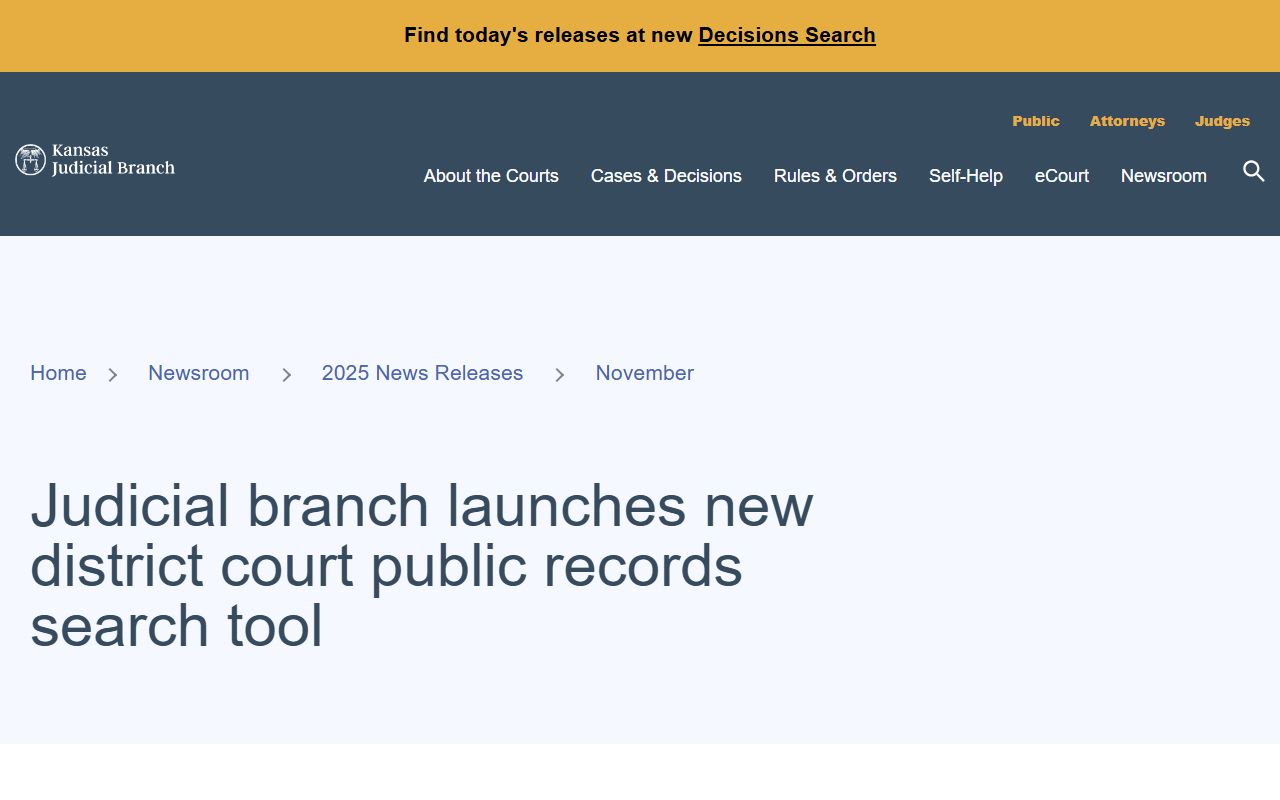
The launch source matters because older references to the former public portal should not be used as the main Elk County docket path.
Elk County Docket Entry Fields
Research did not capture a live public sample docket from CaseSearch because several Kansas court pages and the portal blocked command-line inspection. The field inventory below uses the court-record fields documented in the research file and the types of entries a public Kansas docket may show. It should be read as a field guide, not a promise that every field appears in every case.
| Field | What It Shows |
|---|---|
| Case Number | The file number used for online search, clerk appointments, and written requests. |
| Entry Date | The date a filing, order, notice, payment, hearing, or disposition was added. |
| Event Type | The category of docket action, such as motion, hearing, journal entry, plea, or judgment. |
| Party or Attorney | The person, lawyer, or office tied to the filing when public. |
| Hearing Date | The scheduled or completed court date tied to the event. |
| Disposition | The outcome of the case, claim, or charge when it has been resolved. |
Elk County Courts With Dockets
The primary docket source is Elk County District Court because Kansas District Court is the county-level state trial court. It handles the broad set of case types: civil, criminal, traffic, probate, family, juvenile, small claims, and protection orders. The Clerk of the District Court processes and maintains legal documents, enters case dispositions on court computers, schedules court appearances, receives fine payments, and provides counter service for court matters.
Howard Municipal Court is the main local lower-court procedure identified in the research. It handles city citations, ordinance matters, and municipal misdemeanor issues. Its process starts with tickets turned in to the City Clerk, a case number assigned by the clerk, and a first appearance at the City Office. Contested matters move to a city court hearing at the Cox Building. Federal dockets are separate and are searched through PACER, not through Elk County District Court.
- Elk County District Court: broad county trial-court docket for state cases.
- Clerk of the District Court: local office for docket questions, copies, appointments, and file review.
- Howard Municipal Court: city citations, ordinance cases, and municipal misdemeanor workflow.
- Kansas appellate courts: separate appellate records if a District Court case is appealed.
- Federal courts: District of Kansas and bankruptcy records through PACER and federal court systems.
The official Elk County directory provides local department contacts tied to court and records access.
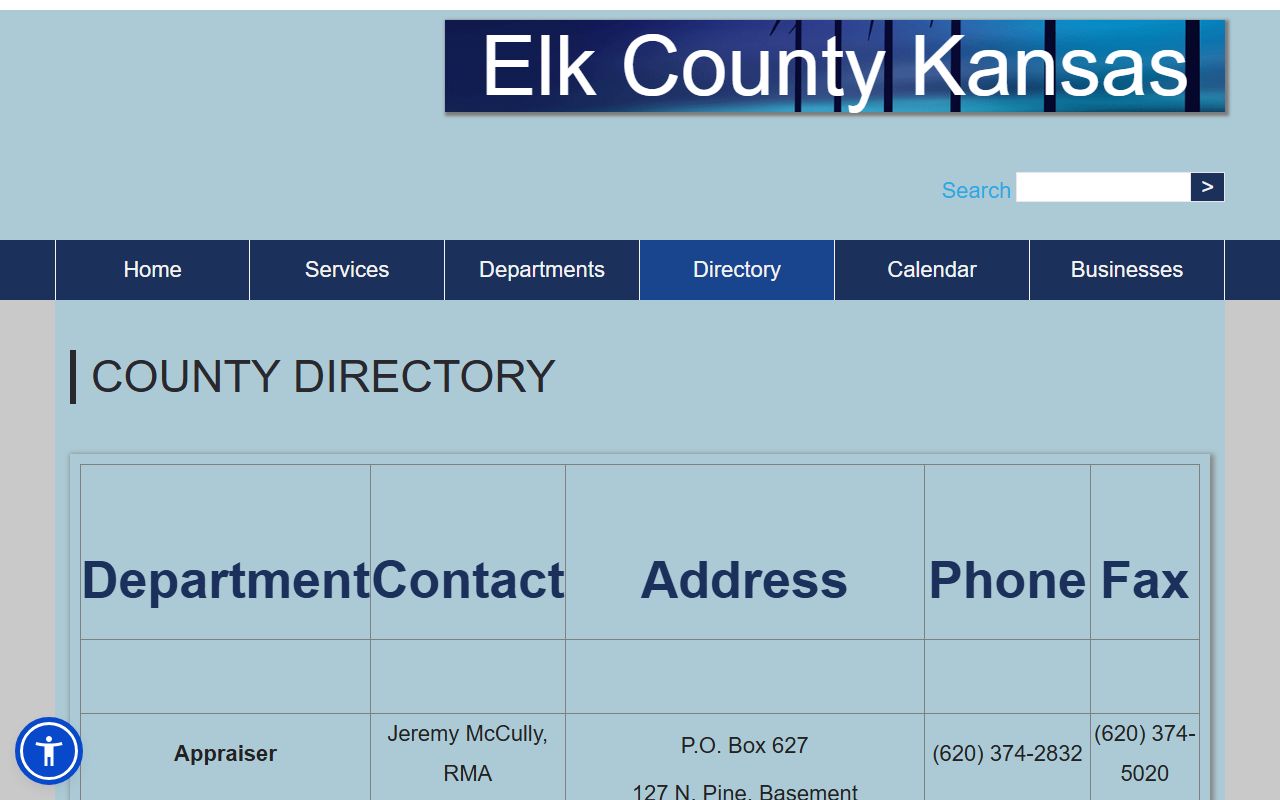
The directory helps confirm which local office to call when a docket search points to the wrong record custodian.
Elk County Dockets vs Case Records
A docket is a map of case activity. A full case record includes the map plus the filings, orders, pleadings, notices, judgments, and other documents that sit behind the docket events. For routine status checks, the docket may be enough. For legal review, certified copies, exhibits, sentencing orders, divorce decrees, probate letters, or recorded hearings, the full case file or clerk-issued copies may be required.
| Docket | Full Case Record | |
|---|---|---|
| Format | List of dated case events | Docket plus pleadings, orders, filings, and documents |
| Best use | Confirm case status and hearing history | Review legal content or obtain official copies |
| Access path | CaseSearch, terminal, or clerk lookup | Clerk appointment, written request, copy request, or certification |
| Limits | May omit document text and restricted events | May include redactions or sealed documents unavailable to the public |
Request Elk County Docket Copies
When a docket search is not enough, use the local request channels. The 13th Judicial District records request form asks for requester name, business or organization if any, address, telephone or email, signature, date, and a specific description of the record sought. If a recorded hearing is requested, the form asks for case name, case number, and hearing date, with a separate request for each hearing recording.
The form says completed requests should be emailed to the Court Administrator at dawn.rouse@kscourts.gov. Payment types listed in the research include cash, cashier's check, money order, personal check, debit cards, and credit cards, with photo ID rules for checks and cards. The local court fee schedule lists copy, research, certification, authentication, fax, email, and recorded-hearing charges.
| Request Need | Best Elk County Channel |
|---|---|
| Find a public docket entry | Kansas CaseSearch or courthouse public access computer |
| Review a public file | Appointment with the Clerk of the District Court, case number required |
| Get a copy | Written request to the 13th Judicial District court records process |
| Get a certified document | Clerk of the District Court copy and certification process |
| Check a Howard ticket | Howard Municipal Court and City Office procedure |
Restricted Elk County Docket Entries
Dockets can be public while some documents remain closed. Juvenile case records have special Kansas Chapter 38 rules. Sealed and expunged records may be missing from public search or may show only limited information. Adoption records, mental-health matters, care-and-treatment materials, confidential addresses, minor names, Social Security numbers, and sensitive victim details may be redacted or unavailable.
K.S.A. 45-221 is relevant because it identifies records that are not required to be disclosed and supports separating open information from closed information when possible. In practice, that can mean a person sees a docket event without receiving every attachment tied to that event.
K.S.A. 45-221 is also one of the image sources assigned to this docket page.
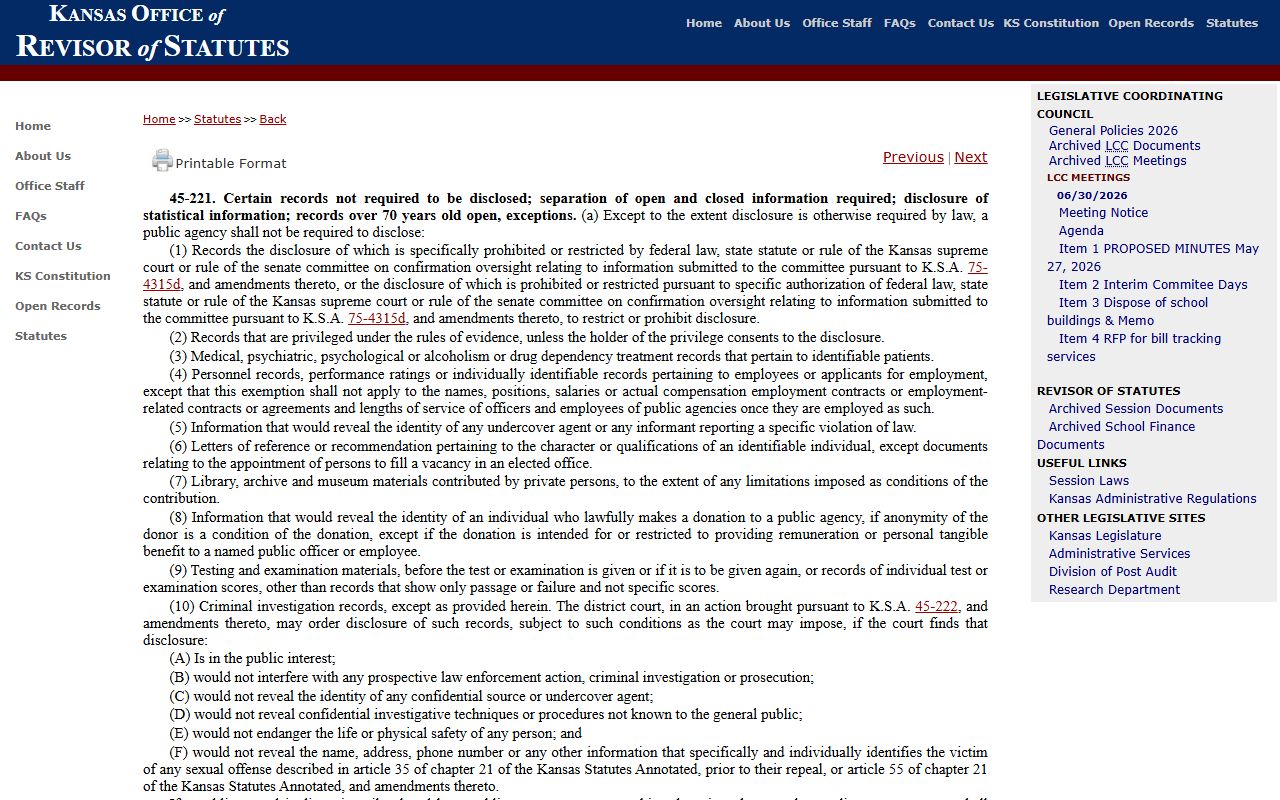
The exception statute helps explain why an online docket may be public even when a related filing is withheld or redacted.
Note: A docket should be confirmed with the originating court before it is used for a deadline, hearing appearance, or legal filing.
Read Elk County Court Dockets
Common docket terms are short, but they carry legal meaning. A complaint may be an initial criminal charging paper or a civil pleading, depending on context. A petition opens many domestic, probate, civil, and protection-order cases. A motion asks the judge to act. An order is the judge's ruling or directive. A journal entry is a Kansas court document that memorializes a judgment, sentence, or ruling.
Criminal docket reading requires extra care. A charge is not the same as a conviction. A diversion can appear after charges are filed, but successful completion may lead to dismissal rather than conviction. A dismissed count can be dismissed with prejudice, meaning it cannot be refiled, or without prejudice, meaning refiling may still be possible. Bond entries, probation notes, restitution, and jail or prison credit may also appear in criminal records when public.