
What Probate Covers in Elk County
Probate in Elk County covers the court process for administering a decedent's estate, proving a will, appointing a personal representative, giving notice to creditors, inventorying property, resolving claims, and distributing assets. The probate docket can also include guardianship and conservatorship matters when a person needs court-appointed help with personal or financial decisions.
Elk County has no separate probate courthouse. Probate matters are filed in Elk County District Court at the Elk County Courthouse. The official District Court page says the Clerk of the District Court processes and maintains legal documents and that most records retained by the clerk are public, subject to court rules and statutory limits.
Probate Terms Defined
Probate files use court and estate terms that can be confusing during a record search. These definitions help distinguish a will filing from an estate administration, a personal representative appointment, or a protective proceeding.
- Testator
- The person who made a will.
- Executor
- A person named in a will to carry out estate administration, often called a personal representative in court practice.
- Intestate
- Dying without a valid will, which means Kansas succession rules may control distribution.
- Letters testamentary
- Court-issued authority showing a representative may act for an estate.
- Guardianship
- A court proceeding focused on personal care and decision-making for another person.
- Conservatorship
- A court proceeding focused on managing another person's property or financial affairs.
How to Search Elk County Probate division / probate docket of the District Court
Start with Kansas CaseSearch for public probate case numbers, estate names, party names, and docket events. Kansas CaseSearch is the statewide district court public-records portal, so it is the online starting point for Elk County probate cases rather than a county-only database.
The K.S.A. 59-1507b small-estates statute page is an official source for the small-estate affidavit route.
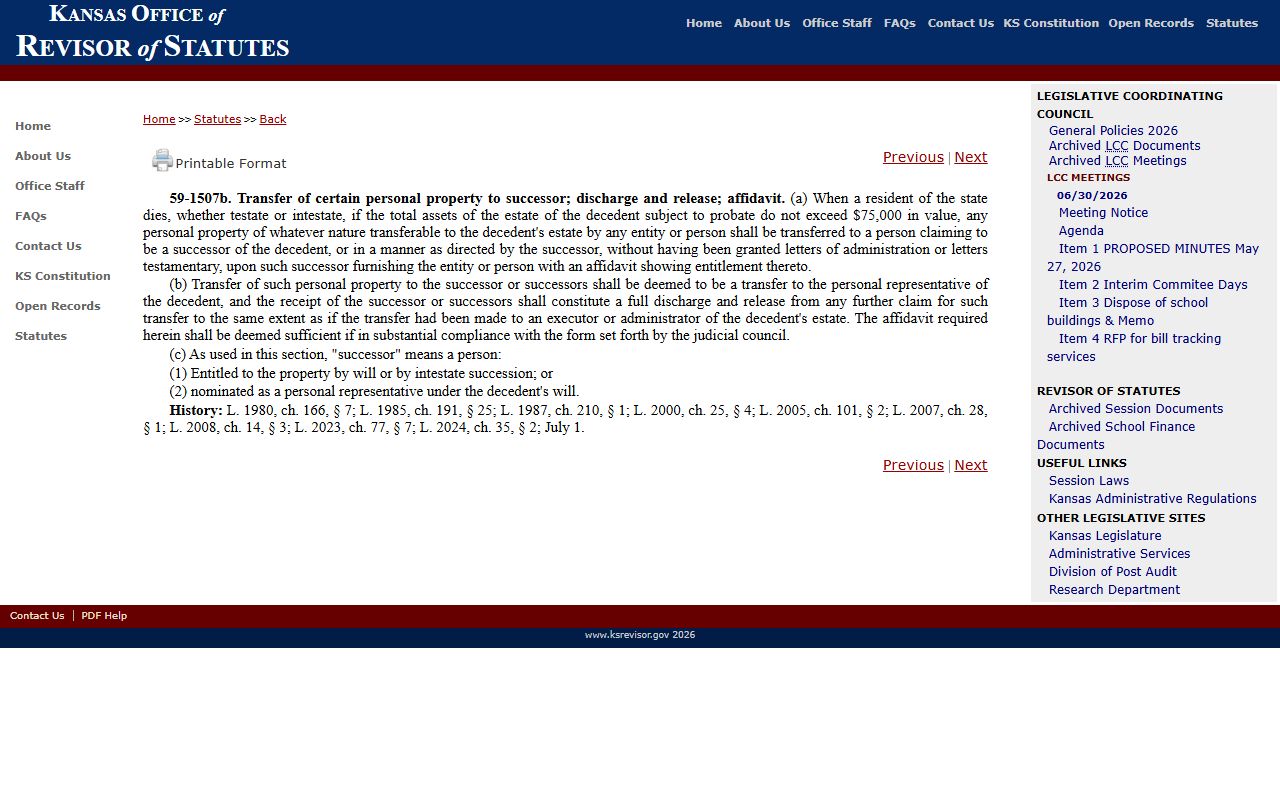
This statute matters because some qualifying personal-property transfers may not produce the same full probate docket as a formal estate case.
- Search Kansas CaseSearch by estate name, decedent name, case number, or party name.
- Use probate, case-status, or date filters when the portal makes them available.
- If the online result does not show the needed document, call the Clerk of the District Court at 620-374-2370.
- For file review, request an appointment and provide the case number associated with the file.
- For copies, use the 13th Judicial District written records request process.
Probate Courts in Elk County
Elk County probate matters are heard through District Court. The county District Court page names Hon. Joe E. Lee as Magistrate Judge and Erin Meador as Clerk of District Court. Court files open to the public may be reviewed by appointment with the clerk when the requester provides the case number.
Elk County District Court
127 N. Pine, 2nd Floor
PO Box 306
Howard, KS 67349
620-374-2370
Monday-Friday, 8:00 a.m. to 4:30 p.m.; clerk counter hours include lunch closure and a Thursday staff-meeting closure.
Probate Filing Fees
Elk County-specific probate filing fees were not located in the official research sources, so filing charges should be confirmed with the Clerk of the District Court before submission. The official record-copy and research fees below are the researched court-record charges for Elk County court files.
| Item | Amount |
|---|---|
| Probate filing fee | Fee not located in official Elk County sources; confirm with Clerk of the District Court |
| Copy fee | Minimum $0.50 per page |
| Certification fee | Minimum $1.00 per certified document |
| Authentication fee | Minimum $3.00 per packet |
| Research fee | Minimum $12.00 per hour |
| Recorded hearing copy | $50.00 per hearing, up to one day in length |
What Elk County Probate division / probate docket of the District Court Show
Probate records may show the petition for probate or administration, original will or will-copy filing, order admitting a will, order appointing an administrator or executor, letters testamentary, heir and devisee information, creditor notices, publication proof, inventories, claims, sale orders, accountings, final settlement, and distribution orders. Guardianship and conservatorship files may include petitions, medical or capacity information, annual reports, accountings, and orders.
The Kansas Probate Code chapter index is the official statute index for Chapter 59 probate proceedings.
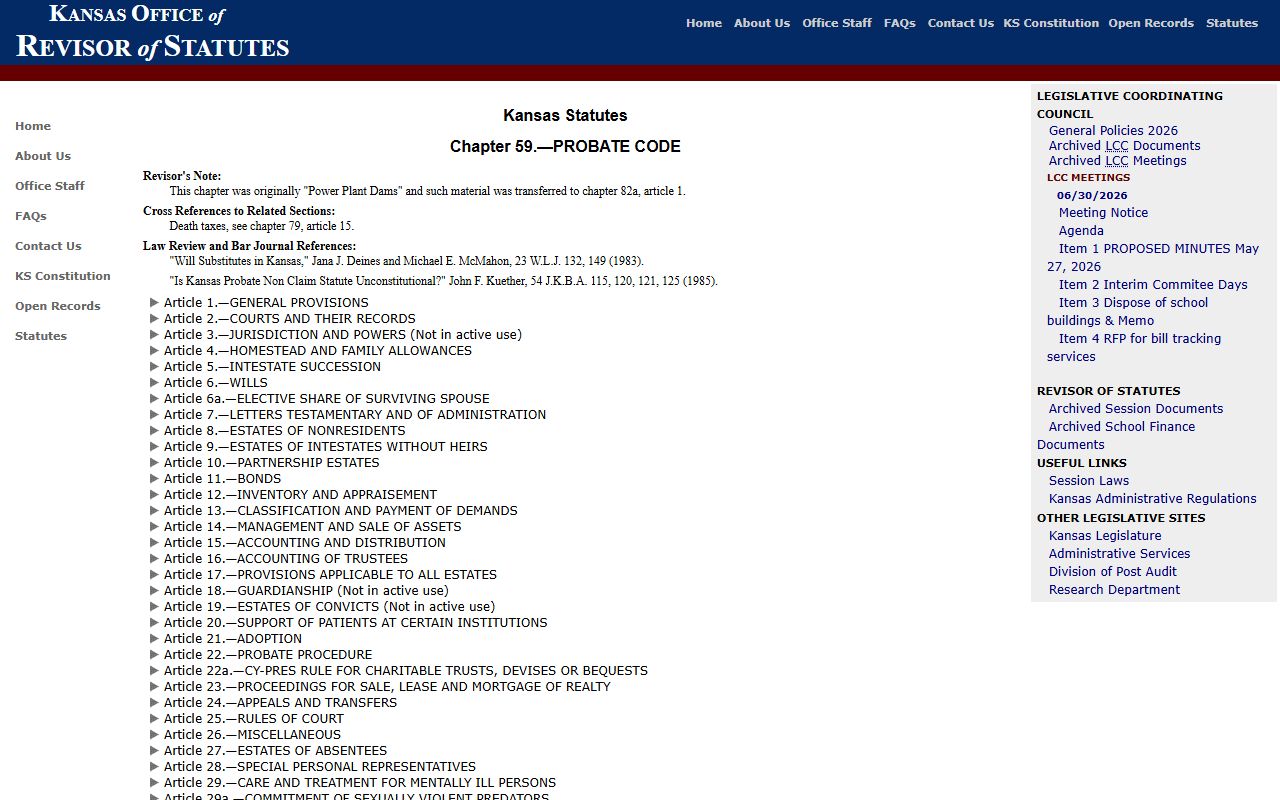
Chapter 59 explains why probate searches may involve wills, administration, notices, inventories, court books, copies, and appeals from district magistrate judges.
Restricted Probate division / probate docket of the District Court
Not every probate-related document is open in full. Minor guardianship, conservatorship, mental-health, medical, financial, and sealed filings may be restricted or redacted. Kansas public-access rules and KORA principles allow open portions to be separated from closed information when possible, but the clerk cannot release confidential details just because a docket exists.
For older or historical family research, also consider the Elk County Register of Deeds. Its official page lists genealogy records, historic birth, marriage, and death records from 1885-1911, and old land records back to 1871. Those sources can support probate research when a formal court file is incomplete or difficult to locate.