
How to Search Elk County Court Records
The online search path is Kansas CaseSearch. Elk County does not publish a separate county-built case database. The 13th Judicial District Elk County page routes users to Smart Search, and Kansas Judicial Branch materials state that CaseSearch replaced the former Public Access Portal for district court public records. Use the statewide system for District Court cases first, then use the local clerk if the case is missing, too old, partly restricted, or requires a certified copy.
Search results should be treated as lead information. A public result may show the case number, parties, case type, court location, filing date, status, and docket events, but not every document is online. For a complete file review, the 13th Judicial District Elk County page says court files open to the public may be accessed by appointment with the clerk, and the case number must be provided. Written requests for information are required, and the court has three business days to respond.
- Search Kansas CaseSearch by case number when the number is known.
- Try party name, business name, or citation search when there is no case number.
- Use case type, case status, date, or county filters if those filters are visible.
- Compare names, filing dates, and court location before opening or relying on a result.
- Use the clerk appointment, courthouse public terminal, or written request form for missing or certified records.
Elk County Court Records Search Fields
CaseSearch field options can vary by user role and public-access rules. Research captured official search references and the Kansas Smart Search guide, but the portal blocked command-line inspection. The safest way to use the tool is to start with the most exact identifier, then broaden the search only when needed. A citation search can help with traffic or fish-and-game matters that entered District Court.
| Field Label | Type | Required | Notes / Format |
|---|---|---|---|
| Case Number | Text | Optional unless using case-number search | Best for exact District Court file lookup. |
| Party Name | Text | Optional unless using party search | Use the name as it appears in pleadings. |
| Business Name | Text | Optional | Available for business-party searches. |
| Citation | Text | Optional | Useful for citation matters that entered District Court. |
| Case Type | Dropdown or filter | Optional | May separate criminal, civil, probate, family, traffic, and other case categories. |
| Case Status | Dropdown or filter | Optional | Use when narrowing active, closed, or other visible status groups. |
Types of Elk County Court Records
Elk County District Court records cover the main trial court work for the county. Civil records may include petitions, answers, service returns, motions, judgments, garnishments, liens, and releases. Criminal court records may include complaints, charges, bond entries, pleas, motions, diversion entries, sentencing orders, probation conditions, and disposition events. Family records include divorce, parentage, custody, child support, and protection-order filings.
Probate is handled as a District Court probate docket. Juvenile records are governed by Kansas Chapter 38 and are not ordinary public adult criminal records. Traffic records may appear in District Court or in Howard Municipal Court depending on the ticket. For DUI or misdemeanor cases that move into criminal court, the full case file belongs with Elk County criminal court records.
- Civil: lawsuits, limited civil matters, small claims, judgments, liens, and garnishments.
- Criminal: charges, hearings, pleas, diversion, conviction, sentence, and court supervision entries.
- Domestic: divorce, parentage, support, custody, and protection orders.
- Probate: estates, wills, heirs, guardianship, conservatorship, and small-estate matters.
- Traffic: district traffic cases, fish-and-game matters, payment records, and municipal citation fallbacks.
What Elk County Court Records Show
What appears in a court record depends on case type, access level, and redaction. A civil file may show parties, attorney names, petitions, orders, service, judgments, and collection steps. A criminal file may show charge statute, severity, offense date, arresting agency, bond, plea, diversion, sentence, probation, restitution, and jail or prison credit. Probate and family cases use different labels, but the same basic idea applies: the docket tracks court events, while the file contains the papers tied to those events.
| Field | What It Shows |
|---|---|
| Case Number | The official identifier needed for CaseSearch, clerk appointments, and written requests. |
| Filing Date | The date the case opened or a specific document entered the docket. |
| Parties | Names of plaintiffs, defendants, petitioners, respondents, or other case participants. |
| Case Status | Whether the matter appears active, closed, pending, or otherwise marked in the system. |
| Docket Entries | Chronological filings, hearings, orders, notices, payments, and disposition events. |
| Disposition | The outcome of the case or charge, such as judgment, dismissal, plea, conviction, or diversion. |
Elk County Court Records Access Rules
Kansas Open Records Act principles apply broadly to public records, but court files also follow Kansas court rules. K.S.A. 45-215 states the open-records policy. K.S.A. 45-220 covers request procedures, inspection, copies, and custodians. K.S.A. 45-221 lists exceptions and supports separating open and closed portions where possible.
Kansas Supreme Court Rule 22 is the key court-record rule for public electronic district and appellate case access. Elk County users should expect a mix of online access, courthouse terminal use, clerk appointments, and written requests. The 13th Judicial District court-record form also requires certification tied to K.S.A. 45-230, which bars prohibited commercial use of lists of names and addresses from public records.
Note: Public access means eligible inspection or copies, not unlimited online document downloads from every Elk County court file.
The Kansas Judicial Branch court-record request page is an official source for court-copy and certification guidance.
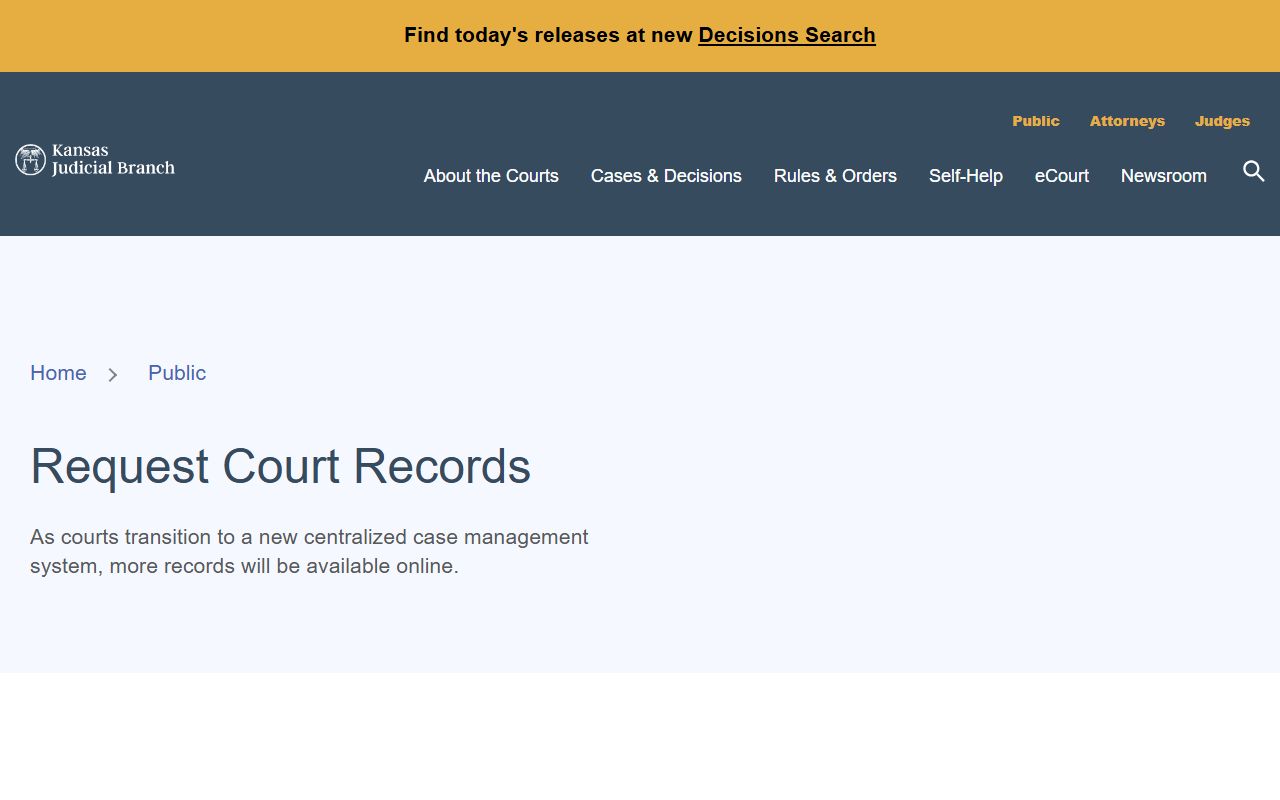
State-level request guidance helps when an Elk County search result does not provide the document or certification needed.
Elk County Court Records Fees
The local fee schedule comes from the 13th Judicial District Elk County page and court records request form. Copies of court documents are listed at $0.50 per page plus research time when staff work is needed. Email records that take less than one hour of research and compilation are no cost, while staff time over one hour uses the research fee. Recorded hearing requests need case details and are priced separately.
| Item | Amount or Rule |
|---|---|
| Document copies | $0.50 per page |
| Research time | $12.00 per hour, minimum one hour for each request on the form |
| Certification | Minimum $1.00 per certified document |
| Authentication | Minimum $3.00 per packet |
| Recorded hearing | $50.00 per hearing for each day conducted |
| Email records | No cost if less than one hour of research and compilation |
Sealed Elk County Court Records
Restricted records include more than sealed criminal files. Juvenile court and law-enforcement records have special rules under Kansas Chapter 38. Adoption, mental-health, care-and-treatment, and minor-related records may be closed or partly closed. Protection-order cases can include confidential address and safety information. Public copies may redact Social Security numbers, full dates of birth, bank data, minor names, and victim-specific details.
Expungement is different from ordinary redaction. Under K.S.A. 21-6614, certain adult convictions, arrest records, and diversion agreements may be eligible for expungement after waiting periods and conditions. Kansas Judicial Council forms can help identify the filing path, but the final order comes from the court. A public search that does not show an expunged record should not be read as proof that the event never existed for every legal purpose.
The K.S.A. 45-215 source page was captured as an image for the open-records framework.
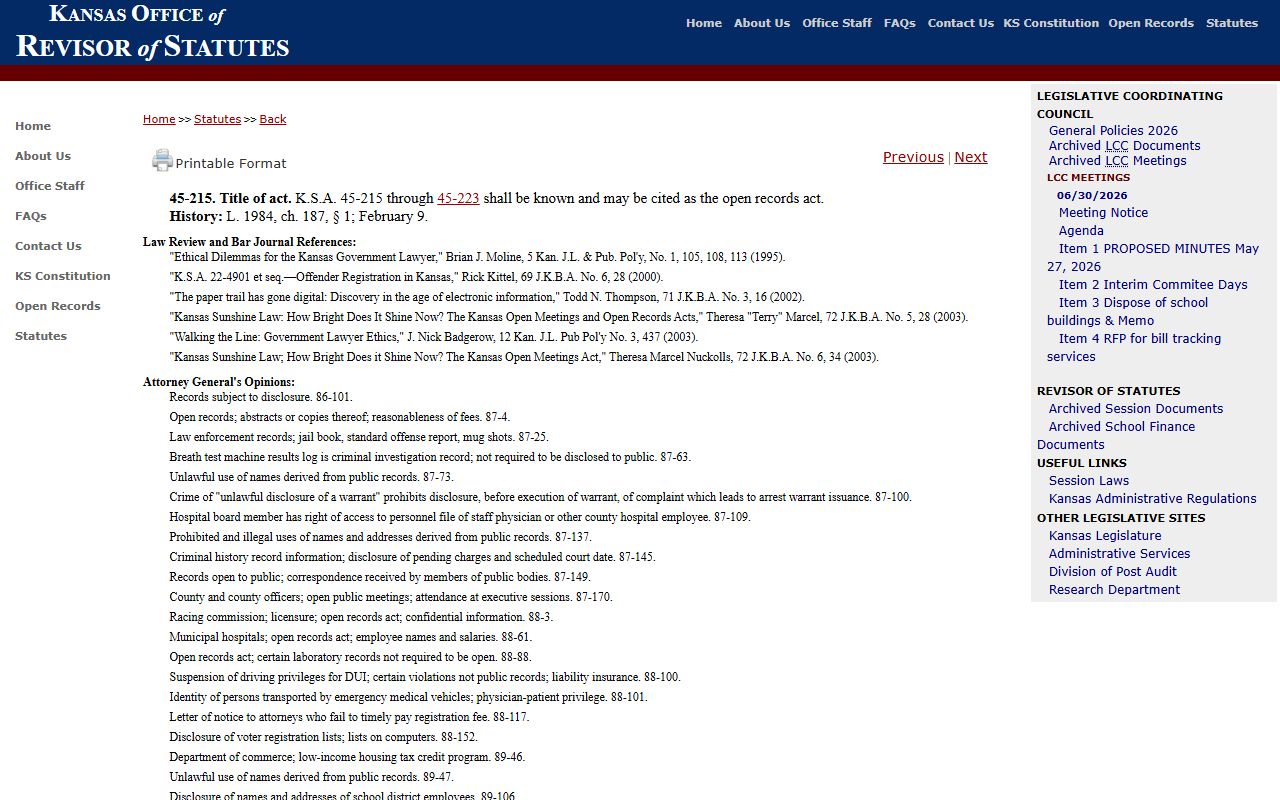
The statute source frames public access, while later exceptions and court rules explain why some court records stay limited.
In-Person Elk County Court Record Requests
The Clerk of the District Court is the local court-record office. The office processes traffic, civil, and criminal cases, receives and receipts money, helps attorneys and the public on court matters, maintains legal documents under court rules and state statutes, enters dispositions, and schedules appearances. Court files open to the public may be reviewed by appointment, and the case number must be provided for file-review appointments.
Written requests use the 13th Judicial District public-record form. The form asks for name, business or organization if any, address, telephone or email, signature, date, the specific nature of the request, and case numbers if applicable. Recorded hearing requests require case name, case number, and hearing date, with a separate request for each hearing recording.
Elk County Court Clerk's Office
127 N. Pine, PO Box 306
Howard, KS 67349
620-374-2370
Fax: 620-374-3531
The Kansas Supreme Court Rule 22 page was captured as a court-record access source.
Rule 22 is especially relevant when a record appears electronically but the full file still requires clerk handling.